Crown
an abstract concept does not exist, it can not cross into reality;
it is non sense;
sourceCrown: it is an “amorphous, abstract concept”, a “convenient cover for ignorance”;
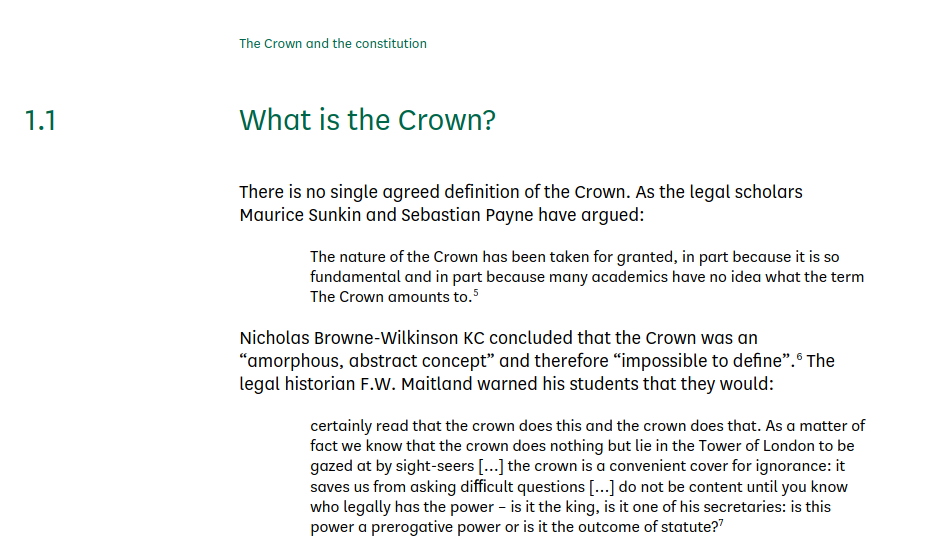
Source: David Torrance, House of Commons Library, The Crown and the Constitution, 4 August 2025;
Crown copyright in Canada
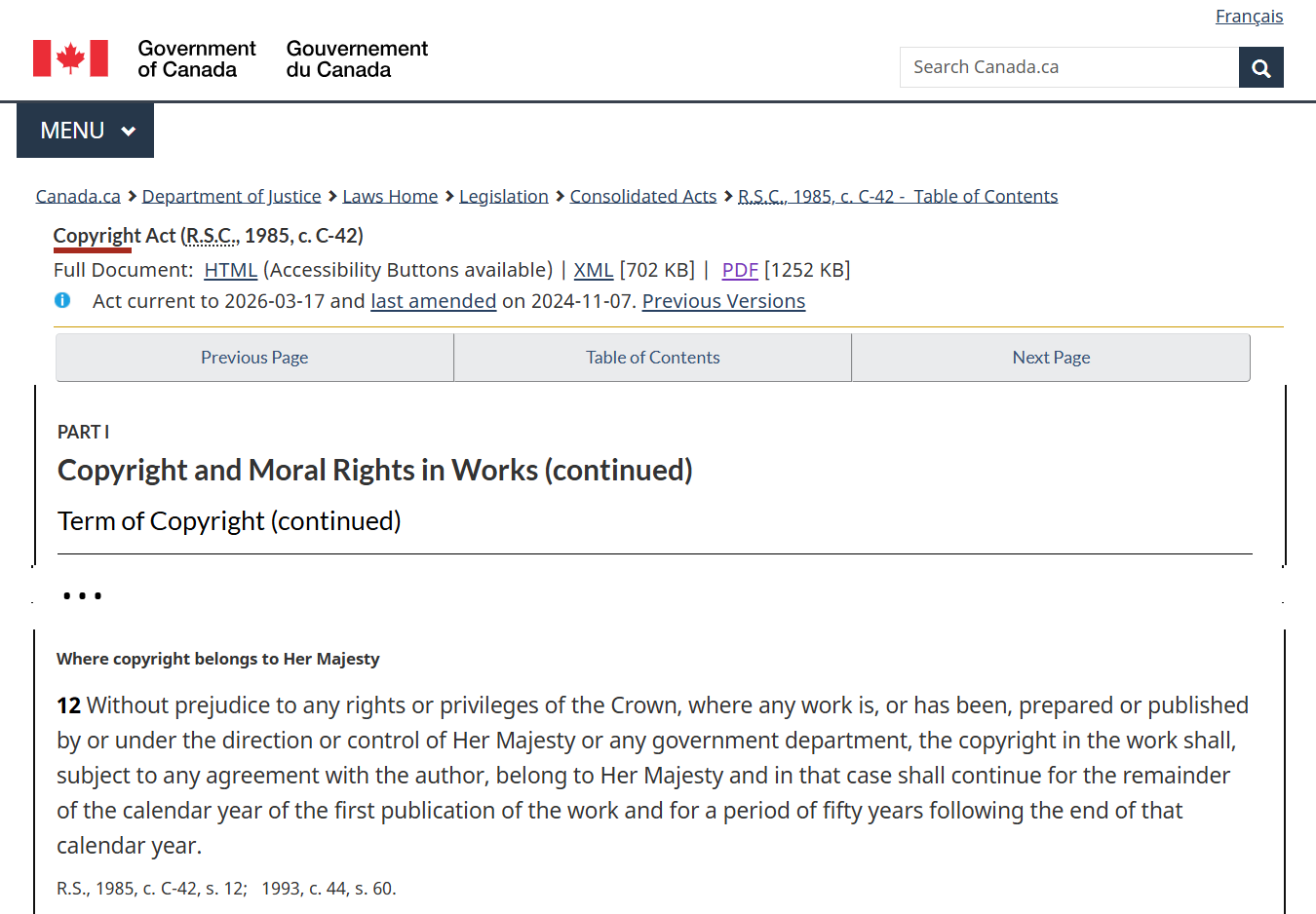
Source: Copyright Act, section 12;
how long copyright lasts
As per the Copyright Act, copyright in a work exists for the life of the author or creator, the remainder of the calendar year in which he is deceased, plus fifty years after the end of that calendar year.
For Crown copyrighted works, section 12 states that copyright continues for the remainder of the calendar year of the first publication and for fifty years following the end of that calendar year.
government identification
© His Majesty the King in Right of Canada, as represented by the Minister of (legal name of department), (year of publication)
Crown copyright is governed by section 12 of the Copyright Act, which covers works “prepared or published by or under the direction or control of Her Majesty or any government department”. The supplied government description records a term until the end of 50 years after the year of creation.
Crown, fiction and its styles
David Torrance writes that the monarch and the Crown are related but separate, and reports a corporation-sole account of the Crown; William Blackstone writes that corporations are artificial persons and that the King is a sole corporation;
sourceCanada’s Copyright Act, section 12: where a work is prepared or published by or under the direction or control of Her Majesty or a government department, “the copyright in the work shall … belong to Her Majesty”;
man is man; “His Majesty”: is a style; King: is a title and office; corporation sole: is an artificial person; Crown: is an abstract concept; Crown-in-Parliament and Crown copyright: are categories; all of them are fiction; fiction can not do a deed; it is non sense;
© Crown copyright [year]: it is an implied claim; a fiction can not own a copyright;
- an imaginary thing can not receive, hold, own, license, or grant authority; it does not exist;
- the chain contains fiction;
- fiction can not cross the boundary into reality;
- to pretend it can is deceit;
Crown fiction in everyday use
identity and personal records
- Driving licences — to legally drive a car in Canada, a driver’s licence is issued by the government of a province or territory. In Ontario, licences are physically issued and administered through ServiceOntario centres and DriveTest locations.
- Birth certificates — in Canada, birth certificates are issued by the vital-statistics office of the province or territory where the birth was registered. The supplied material distinguishes a short form containing personal details from a long form that includes parental names and places of birth.
- Passport — the Government of Canada Passport Program records the Canadian passport service.
- other records include death and marriage certificates, land certificates, and copies of registers or title sheets;
law, road and official process
- Ministry of Transportation — the supplied Ontario material names the Ministry of Transportation as the government body responsible for granting driver’s licences in Ontario.
- Government works — Canada’s Crown-copyright material points to section 12 of the Copyright Act for work prepared or published by or under the direction or control of Her Majesty or a government department.
- Vehicle registration — Ontario provides a route to register and insure a vehicle.
forms, registers, maps and signs
- Postal codes — postal codes are managed by Canada Post Corporation for the efficient sorting and delivery of mail. Statistics Canada provides links between postal codes and standard geographic areas for analysis and mapping.
- Land Titles Act — the supplied Ontario extract records an application by or on behalf of a minister of the government of Canada or Ontario to register land claimed to be owned by the Crown in right of Canada or Ontario.
- Canada Revenue Agency — the official agency page records the federal tax and benefit service.
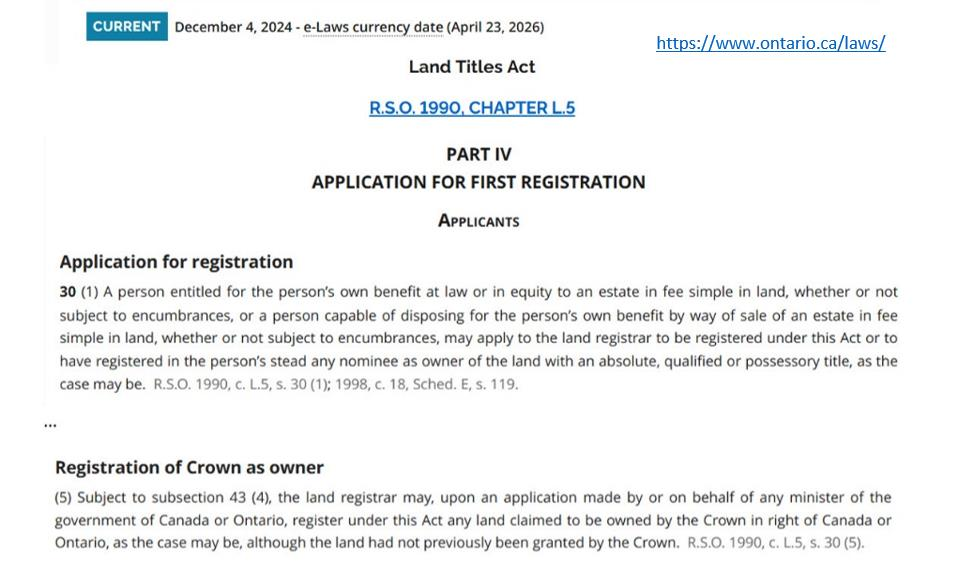
Land Titles Act
First registration
(7) The Director of Land Registration and the Director of Titles shall perform such functions relating to the first registration of land under this Act as are required. R.S.O. 1990, c. L.5, s. 10 (7); 1998, c. 18, Sched. E, s. 108 (3).
Registry Act
Land registry offices
6 (1) Every land titles office, including every combined registry office and land titles office, shall be known as a land registry office. R.S.O. 1990, c. L.5, s. 6 (1).
Land titles system
(2) The system of registration under this Act shall be known as the land titles system. R.S.O. 1990, c. L.5, s. 6 (2).
Fee and receiving record
7 Upon receiving an instrument for registration or deposit, the land registrar shall record it and the fee charged in a manner approved by the Director of Land Registration. R.S.O. 1990, c. L.5, s. 7.
MPAC and Teranet
These are outsourced to a private company called MPAC, and Teranet.
MPAC — property assessments; Teranet — land registration; Teranet: Ontario Parcel;
sources
source list
- David Torrance, House of Commons Library, The Crown and the Constitution, 4 August 2025, summary and section 1.1, pages 6–9;
- William Blackstone, Commentaries on the Laws of England, Book I, chapter 18, star pages 467–470: corporations are artificial persons; the King is a sole corporation;
- Canada, Copyright Act, section 12;
- Government of Canada Crown-copyright FAQ and Crown-copyright identification and policy;
- Canada: driving licences; Ontario: getting a driver’s licence;
- Ontario certificates and Office of the Registrar General;
- Passport Program;
- Ontario Ministry of Transportation and register and insure a vehicle;
- Statistics Canada: postal codes;
- Ontario, Land Titles Act: supplied extracts; Registry Act;
- MPAC: property assessments; Teranet: land registration; Teranet: Ontario Parcel;
- Canada Revenue Agency;